

In this guide
A male BBL is buttock augmentation using your own fat, collected through liposuction and transferred to the buttocks. It can aim for greater projection, a squarer outline or a different balance between the waist and buttocks—not necessarily a curvier silhouette. It is major surgery with potentially serious complications, including fat embolism, where fat enters the bloodstream and can obstruct circulation.
Why men get a BBL: understanding male BBL goals
Men consider buttock augmentation for different reasons. Some want more projection when viewed from the side; others want to address a flatter outline, unevenness or proportions that do not match their preferences. An athletic-looking result may be the aim, but there is no single shape that defines a masculine body.
A Brazilian butt lift for men combines two elements: removing fat from selected areas and placing some of that fat in the buttocks. These should be planned together. A change at the waist or lower back can matter as much to the overall appearance as added buttock volume.
Start with the change you want
Useful descriptions include “more fullness from the side”, “less change across the outer hips” or “a straighter outline from waist to thigh”. These are clearer than asking for a particular celebrity’s body or a generic athletic shape. Bring examples of proportions you like, but treat them as discussion tools rather than promised outcomes.
You can also explain what you do not want: prominent lateral curves, a sharply narrowed waist or a noticeable increase in clothing size. Ask the surgeon to explain what your starting anatomy makes achievable.
Consider the trade-offs
The procedure involves anaesthesia, liposuction and fat injection. Risks include infection, bleeding, fluid collections, altered sensation, contour irregularities, blood clots and fat embolism. A small intended change does not remove these risks.
Suitability depends on your health, donor fat, skin, expectations and ability to follow an aftercare plan—not simply being male or wanting more volume.
Uncontrolled medical conditions, nicotine use or an inability to arrange appropriate recovery support may mean surgery should be postponed or declined. Discuss these honestly with a qualified, registered plastic surgeon.
If you are exploring BBL in Turkey, use the information to prepare questions rather than treating the destination itself as evidence of quality.
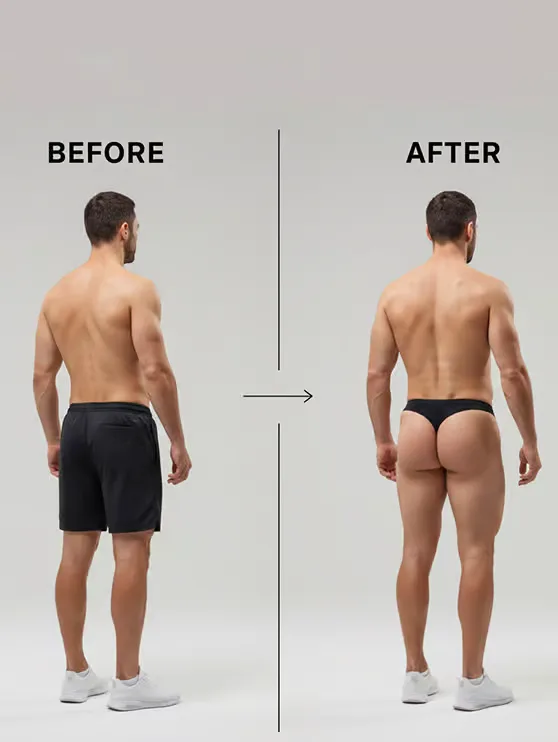
Male vs female shaping goals
The distinction is about preferences, not fixed rules. Some men prefer a square or relatively straight outer contour, with added fullness concentrated towards the back rather than the sides. Others want roundness or wider hips. Equally, women do not all seek an hourglass shape.
A useful consultation translates those preferences into an individual plan. Ask the surgeon to discuss the back, side and three-quarter views, not just one flattering angle.
Preference | Question to discuss |
|---|---|
More side-profile projection | Where would fullness be added, and what change is realistic? |
A squarer outline | How would the outer buttock and hip contours be approached? |
A less rounded waist-to-hip transition | Can flank contouring remain conservative? |
Better balance between sides | Which differences could improve, and which may remain? |
A subtle change | Would liposuction alone meet part of the goal? |
Liposuction is part of the design
Your pelvis, muscle shape, skin elasticity and existing fat distribution influence the result. Surgery cannot reproduce another person’s underlying anatomy.
Contouring around the abdomen, flanks and back may help define the buttock outline. However, more extensive fat removal is not automatically better: excessive removal can create depressions, uneven transitions or loose-looking skin.
The term lipo 360 with BBL describes an approach involving contouring around the torso alongside buttock fat transfer. Ask which areas are actually included; a package name does not explain the operation.
An athletic appearance is not muscle augmentation
Transferred fat changes soft-tissue volume; it does not increase gluteal strength or create trained muscle. Exercise can develop muscle, but it cannot promise the same distribution of volume as surgery.
Whatever shape is requested, the injection plan must prioritise anatomy and risk reduction. Current specialist guidance favours fat placement in the subcutaneous layer—beneath the skin and above the gluteal muscle—and real-time ultrasound to verify cannula position during injection. These measures do not eliminate risk.
Donor fat in leaner men
Having little body fat can limit what a BBL can achieve. A consultation needs to establish whether enough suitable fat can be collected without over-treating the donor areas. Appearance in photographs, body weight or a single measurement cannot settle that question on its own.
Where donor fat may come from
Potential donor areas include the abdomen, flanks, back and thighs. The surgeon assesses the amount and distribution of fat, skin quality, previous liposuction and how each area might look after removal. Fat removed through liposuction also needs preparation before transfer; the amount removed is not the same as the amount available for injection.
Ask for an explanation of both sides of the plan: what the buttocks may gain and what the donor areas may lose. If your main concern is projection, an aggressive waist reduction may not match your priorities.
What if there is not enough fat?
Options may include accepting a smaller change, considering contouring without fat transfer, discussing a different operation or choosing not to proceed. Limited donor fat should not be treated as a reason to remove excessive amounts from already lean areas or chase a predetermined injection volume.
Do not assume you need to gain weight to qualify. Deliberate weight change requires individual discussion, and maintaining a stable, sustainable weight matters because later changes can alter the result. Avoid crash diets or rapid weight-gain plans marketed as surgical preparation.
Implants and loose skin require separate conversations
Buttock implants are different from fat transfer. They may be discussed when donor fat is limited, but introduce an implanted device and risks such as infection, displacement, wound problems and further surgery. They are not an automatic substitute for a BBL.
Similarly, adding volume does not reliably correct substantial loose skin. After significant weight loss, a skin-removal procedure may be more relevant, with different scars and recovery demands.
Ask the surgeon to explain why each option fits—or does not fit—your anatomy, rather than choosing from a treatment menu.
Results and recovery
Assess results in terms of proportion, symmetry, clothing fit and whether the agreed goals were met—not just the amount of fat injected. Early swelling can make both the buttocks and liposuction areas look different from their later appearance. Some transferred fat is reabsorbed, and the final contour is not immediately apparent.
Reading before-and-after photographs
When reviewing male BBL before and after images, look for comparable starting builds and goals. Ask whether the photographs show fat transfer alone or additional procedures, and how far into recovery the later images were taken.
Consistent lighting, posture, camera distance and clothing make comparisons more useful. Check side and rear views: one image cannot show all aspects of projection and width. Photographs also cannot tell you how someone felt during recovery or whether they experienced complications.
Our guide to BBL before and after photographs explains how to interpret images without treating another patient’s result as a forecast for your own.
Plan around milestones, not a fixed promise
Your recovery plan should explain sitting, sleeping, wound care, compression garments, work, driving, exercise and follow-up. Instructions vary with the operation and individual health; a package itinerary is not a substitute for clinical advice.
Direct pressure on the treated buttocks may need to be limited during early healing. Ask your surgeon for specific positioning instructions and whether a cushion is appropriate; buying a marketed “BBL pillow” does not replace that plan.
Discuss desk work, commuting and long periods of sitting before booking. For physical jobs, describe the lifting, bending or driving involved rather than asking only when you can “return to work”. Arrange practical help if daily tasks would conflict with your instructions.
Gentle movement and strenuous training are different stages of recovery. Walking, weight training, running and direct gluteal exercises should be resumed according to your surgical team’s guidance, not an online timetable.
Recovery abroad needs a home plan
Surgery and prolonged immobility, including during travel, can increase blood-clot risk. You need an individual assessment covering clot prevention and when you are fit to fly; a pre-booked return flight is not medical clearance.
Before travelling, clarify who handles urgent concerns, where you would be examined and how follow-up continues after returning home. Obtain your operation summary and written aftercare instructions.
Sudden breathlessness, chest pain, fainting or coughing blood require emergency medical help. New one-sided leg swelling also needs urgent assessment. Do not wait for a routine clinic reply if these symptoms occur.
Fever, spreading redness, increasing wound discharge or worsening pain warrant prompt clinical advice.
Cost and next steps
Male BBL cost depends on the planned liposuction areas, complexity of contouring, anaesthesia, facility arrangements and follow-up. A procedure label alone is not enough to compare quotations. Ask each provider to describe the same proposed treatment and separate clinical fees from travel-related services.
For an editor-verified comparison, current figures should be obtained directly:
Turkey:
UK:
The guide to how much a BBL costs can help structure your comparison. Request a written, itemised quotation showing what is included and what happens financially if plans change.
Check what the quotation covers
Ask about surgeon and anaesthetist fees, operating-facility charges, assessments, garments, medicines and scheduled reviews. If accommodation and transfers are included, confirm their details separately from the medical arrangements.
Clarify who pays for additional investigations, an extended stay, hospital admission or treatment of complications. Read any revision policy carefully: an offer of further surgery does not necessarily include anaesthesia, travel or accommodation. Check insurance exclusions rather than assuming standard travel cover includes elective surgery.
Questions to take to your surgeon
What experience do you have with men seeking a similar contour?
Is my donor fat sufficient for the change I want?
Which areas would you treat, and what would you leave alone?
How do you confirm injection depth throughout fat placement?
Who provides anaesthesia, and what emergency arrangements are available?
Who will assess me if I have a problem after returning home?
Verify the surgeon’s registration, relevant specialist qualifications and the facility’s credentials with the appropriate authorities. Credentials matter, but they do not guarantee an outcome.
An online Brazilian butt lift consultation can begin the discussion, but photographs cannot replace the examination and health assessment needed before surgery.
You can also review the Turkey BBL procedure and planning guide when preparing your questions. A useful consultation should leave room for alternatives, a smaller procedure or no surgery.
The most useful starting point is a clear description of the shape you want, alongside an honest discussion of donor fat, risks and recovery. If you would like to explore your options, request a free online assessment to prepare for a consultation with a qualified, registered plastic surgeon. You do not need to decide on surgery at this stage.
Frequently asked questions
Can a lean man have a BBL?
A lean man may be suitable for a BBL if there is enough usable donor fat and the intended change is realistic. Some men will only be candidates for a modest increase; others may not have enough fat. A qualified plastic surgeon needs to assess donor sites and overall health rather than deciding from weight alone.
Is a male BBL the same as buttock implants?
No. A male BBL transfers your own fat after liposuction, while buttock implants use a manufactured device to add volume. Implants may be discussed when donor fat is limited, but have different complications and recovery requirements. Neither approach is suitable for everyone, and combining procedures requires a separate assessment of the added risks.
When can I return to the gym after a male BBL?
Returning to the gym depends on healing, the extent of liposuction and your surgeon’s assessment. Gentle walking is different from heavy lifting, running or exercises that load the buttocks. Ask for a staged plan covering your usual training and do not use someone else’s recovery schedule as clearance to resume exercise.
Are male BBL results permanent?
Some transferred fat can remain long term, but a male BBL does not produce an unchanging result. Some fat is reabsorbed during healing, while later weight changes, ageing and skin changes can affect the contour. Further treatment may be discussed if the outcome differs from the agreed goals, but revision is not automatically appropriate.
Sources
References used for this article. Figures are only quoted when a source is listed.
- Current multisociety plastic-surgery guidance on gluteal fat grafting, subcutaneous injection and real-time ultrasound
- Professional plastic-surgery patient information on BBL complications and candidate selection
- Peer-reviewed literature on male gluteal contouring goals and anatomical limitations
- Clinical guidance on donor-site assessment, fat processing and liposuction limitations in lean patients
- Professional guidance on weight stability, nutrition and nicotine exposure before elective body-contouring surgery
- Systematic reviews of gluteal implant indications and complications
- Plastic-surgery guidance on skin laxity and excisional contouring after substantial weight loss
- Clinical evidence on fat-grafting durability, swelling and postoperative pressure management
- Professional postoperative guidance on mobilisation and return to exercise after gluteal fat grafting
- NHS guidance on blood-clot symptoms, wound infection and surgery abroad
- Authoritative travel-medicine guidance on postoperative air travel and venous thromboembolism
- Official professional registers and guidance for verifying overseas surgeons and facilities
- Professional standards for remote consultations and preoperative physical assessment
- Itemised clinic-verified quotations for comparable male BBL procedures in Turkey and the UK
About the author
BBL Turkey Editorial Team
Our editorial team writes patient guides together with our plastic surgeons. Medical content is reviewed for accuracy before publication and updated as guidance changes.
Ready to talk to a surgeon?
Send your photos for a free, no-obligation assessment. A coordinator replies within 24 hours — no pressure, no time-limited offers.


