

In this guide
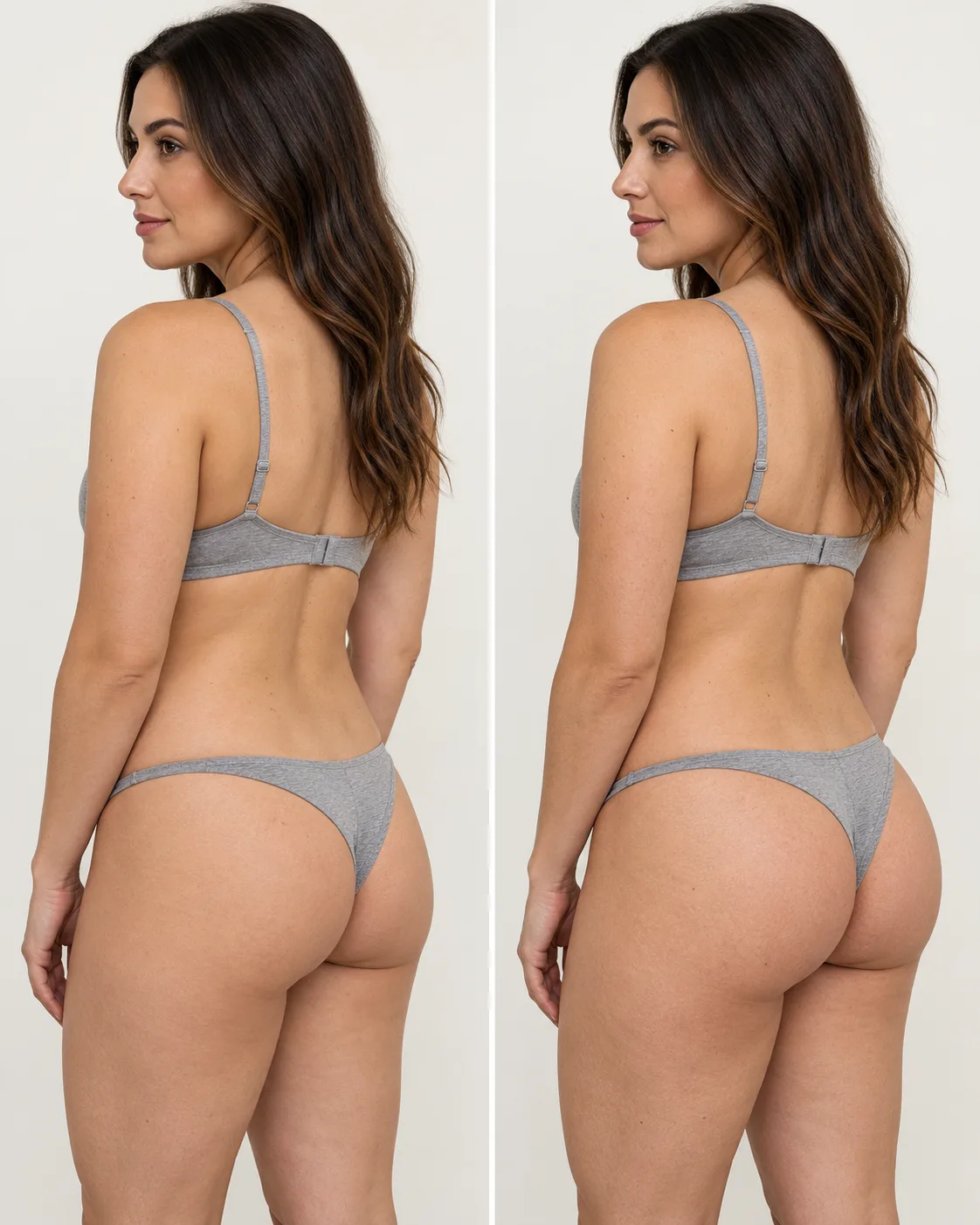
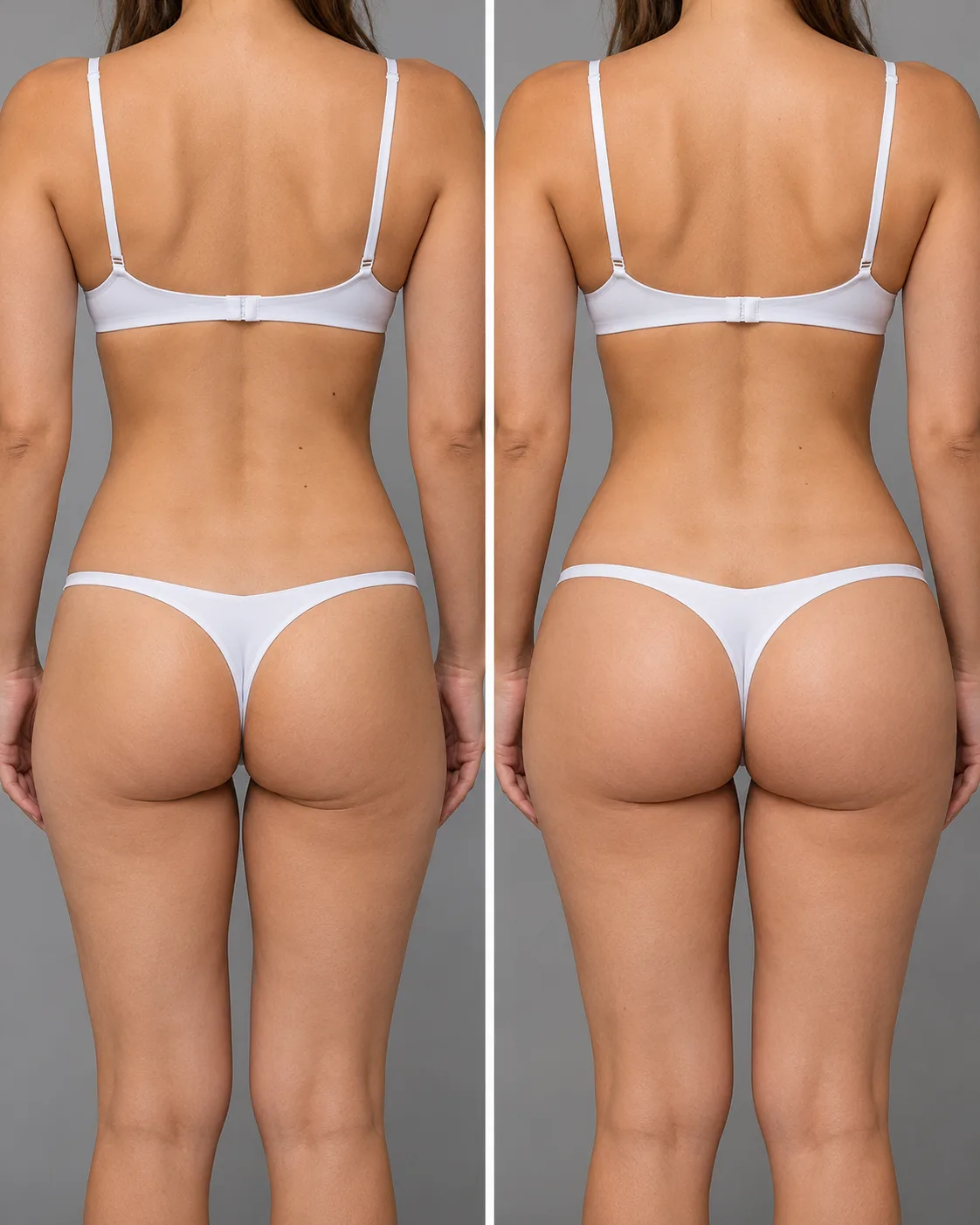
Butt implants before and after photos show a rounder, fuller and more projected buttock, with the change depending on implant size, body shape and skin quality. Results are visible straight away but look different at 2 weeks, 3 months and a year, as swelling settles and the implants soften into position. Honest photos also show scars, asymmetry and limits.
This guide explains what to look for when you view butt implants before and after pictures. It covers what different sizes tend to look like, how results settle, how implants compare with a Brazilian butt lift, and the risks that photos rarely show. It is general information, not individual advice. Only a registered plastic surgeon who has examined you can say what is realistic for your body.
If you are also weighing up fat transfer, our guide to BBL in Turkey explains how that route works.
Gallery by implant size: butt implants before and after
A good gallery of butt implants before and after groups results by implant size range: small, moderate and larger. This helps you see how volume changes the look of the same kind of body. It does not tell you which size is right for you. That depends on your frame, your skin and your goals.
We do not quote cc figures here. Volume numbers are misleading when compared between people. The same implant can look modest on a tall, broad frame and very full on a petite one. Look at the shape in the photo, not the number in the caption.
How to read a size-grouped gallery
When you browse butt implants images, check four things in each pair of photos:
Frame: how wide are the shoulders and ribcage compared with the hips?
Height: a taller person needs more volume to show the same change.
Hip width: implants add fullness at the back. They do not widen the hips much.
Starting point: how much natural tissue and skin were there before surgery?
What each size range tends to look like
Size range | Typical look | Considerations |
|---|---|---|
Small | Subtle lift and gentle roundness. Clothes fit a little differently. | Suits a natural, understated preference. May not fill a very flat starting shape. |
Moderate | Clearly rounder, with more shape from the side. | Often the most discussed range. Needs enough soft tissue to cover the implant. |
Larger | Strong projection and a very visible change. | Higher tension on the skin and wound. Can look out of proportion on a small frame. Surgeon assessment is essential. |
These are general patterns, not promises. Your surgeon will judge what your tissue can safely cover.
How to judge photo quality
Reliable before and after pictures follow a few simple rules:
The same angle in both photos, including front, side and back.
The same lighting and distance from the camera.
A similar pose, with the same posture and no arching.
No filters, smoothing or heavy editing.
A stated time since surgery, so you know if swelling had settled.
If a gallery fails these checks, treat it with caution. The NHS cosmetic procedures guidance is a helpful, neutral starting point before you speak to any surgeon.
What do butt implants look like after surgery?
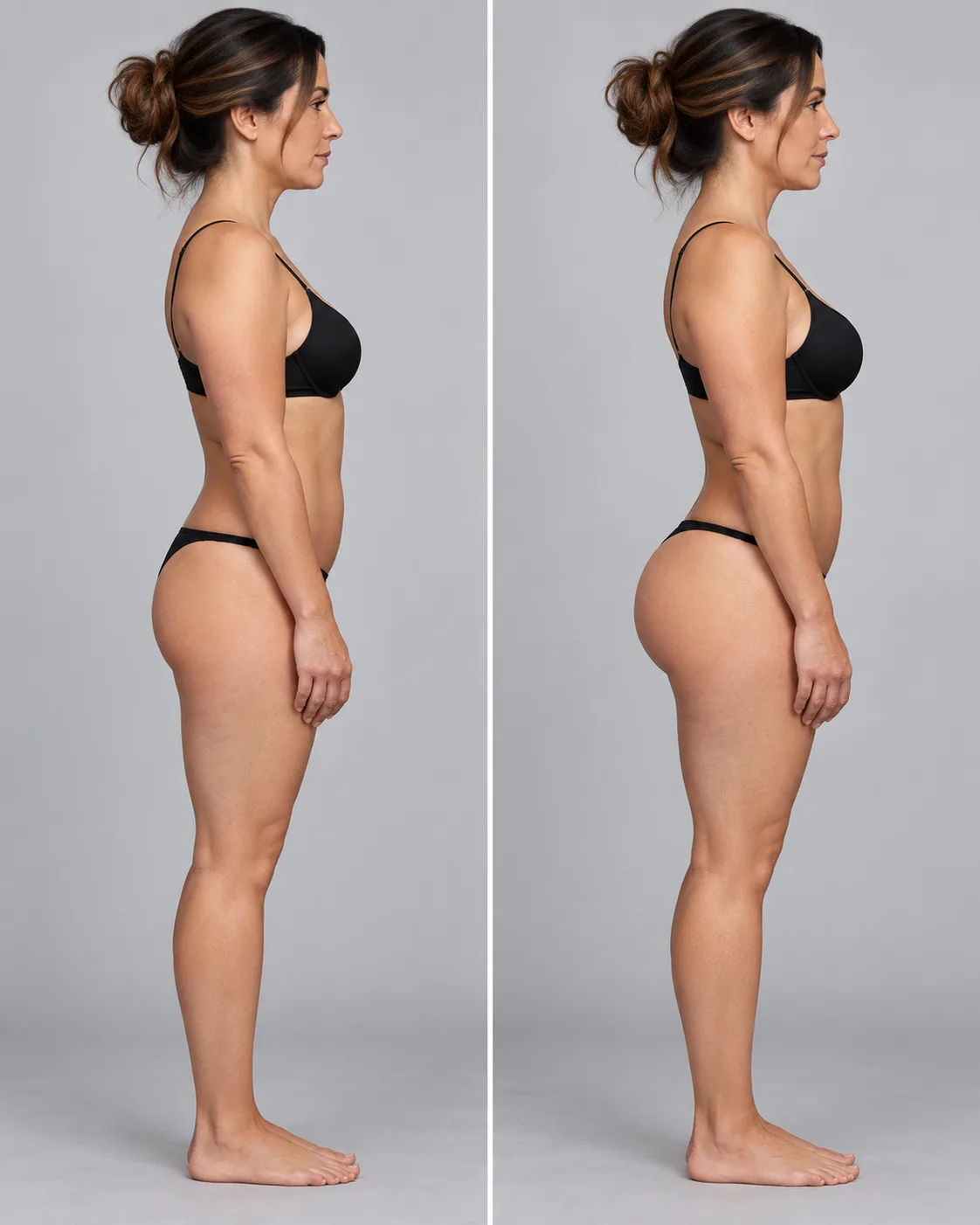
Once healed, butt implants look like a rounder, fuller and slightly higher buttock. The change is most visible from the side, where you see more projection (how far the buttock sits out from the body). From behind, the shape looks more even and defined.
If you are asking what do butt implants look like in real life, the honest answer is that it varies. Implant size, placement, skin thickness and starting shape all change the result.
Shape and upper pole fullness
Implants add volume where you may have had little. Many people notice more fullness in the upper part of the buttock, often called the upper pole. This can give a smoother line from the lower back into the curve of the buttock.
A good result blends with your own tissue. You should not see a hard edge or a distinct outline of the implant under normal light.
Side profile
The side view shows projection best. A small increase can still look clear in profile. A larger increase creates a more dramatic curve. Photos taken from the side are often the most useful way to compare butt implants before and after.
Standing versus sitting
Standing, the buttocks should look round and firm in shape. Sitting, they flatten and spread in the way any buttock does, though implants may feel firmer than fat. Some people notice the implant edge more when seated, especially if they are slim.
When healed, most people can sit normally. Your surgeon will tell you when to return to regular sitting.
Natural or overdone?
This is a personal preference, not a medical question. Some people want a subtle change that others would barely notice. Others want a clear, bold shape. Neither is right or wrong.
What matters is that the size is safe for your tissue and that you chose it with clear eyes. Bring photos you like and photos you do not like to your consultation. They help your surgeon understand your taste.
How results settle
Results settle gradually over several weeks to about a year. Swelling falls first, then the implants soften and sit lower, and scars fade last. Butt implants before after photos taken at two weeks and at a year can look quite different, so always check when a photo was taken.
The pattern below is general. Everyone heals at their own pace, and your surgeon's advice comes first. The NHS overview of cosmetic procedures also stresses that recovery takes time and varies.
A general timeline
First days: The area is swollen, tender and bruised. The shape can look high, tight and firm. This is not the final result.
First two weeks: Swelling and bruising begin to ease. You will likely wear a compression garment and avoid sitting directly on the area, if your surgeon advises it.
Weeks three to six: Much of the visible swelling goes down. Many people return to light daily activity. Strenuous exercise usually waits.
Two to three months: The shape looks more natural. Implants begin to soften into position and feel less tight.
Six months: Most swelling has gone. Tissue feels more settled and flexible.
Around a year: Scars have matured and faded as far as they will. The result is close to final.
Why implants "drop"
Immediately after surgery, implants can sit higher because tissue is tight and swollen. As the tissue relaxes, they settle. This is normal and expected. It is one reason your surgeon will not judge the result early.
Scar maturation
Scars start red or pink and raised, then flatten and fade over months. Sun protection and following wound care advice help. Some people scar more visibly than others.
Tips for tracking your own progress
Take photos in the same light and pose each month.
Note how clothes fit, not just the mirror.
Attend every follow-up.
Report any sudden swelling, fever, wound opening or severe pain at once.
Week-by-week recovery photos: what to expect
Recovery photos in the early weeks look very different from final butt implants before and after images. Expect swelling, bruising, uneven shape and compression garments. Day-one photos are especially misleading because they show tight, swollen tissue rather than the settled result.
Below is a general guide to what recovery photos tend to show. Follow your own surgeon's instructions above anything you read online.
What you may see
Day one to three: Marked swelling and bruising. The buttocks can look high, hard and very round. You will usually be in a compression garment.
Week one: Swelling is still strong. Bruising may spread or change colour as it heals. Movement is gentle.
Week two: Less bruising. Stitches or dressings may be reviewed. Shape still looks tight.
Weeks three to four: Visible improvement. Clothes start to fit more normally.
Weeks five to eight: The shape looks more natural. Your surgeon may relax some restrictions.
Compression garments
A compression garment is a snug elastic garment that supports tissue and helps control swelling. Your surgeon will say how long to wear it. Photos taken with and without one can look quite different.
Sitting and movement
Many surgeons ask patients to limit direct sitting for a period, to protect the wound and implants. You may be told to use a cushion or lie on your front or side. Rules differ between surgeons, so follow yours exactly.
Swelling and asymmetry
Swelling is rarely even. One side can look bigger for weeks. This is common and often settles. If the difference grows, or one side becomes hot, red or very painful, contact your surgical team promptly.
Why day-one photos mislead
Swelling adds volume that will go.
Tight skin makes the shape look firmer and higher.
Lighting and posture can exaggerate the effect.
They say nothing about long-term healing or scars.
Please do not judge your result before several months have passed.
Implants vs BBL photos: how do the results differ?
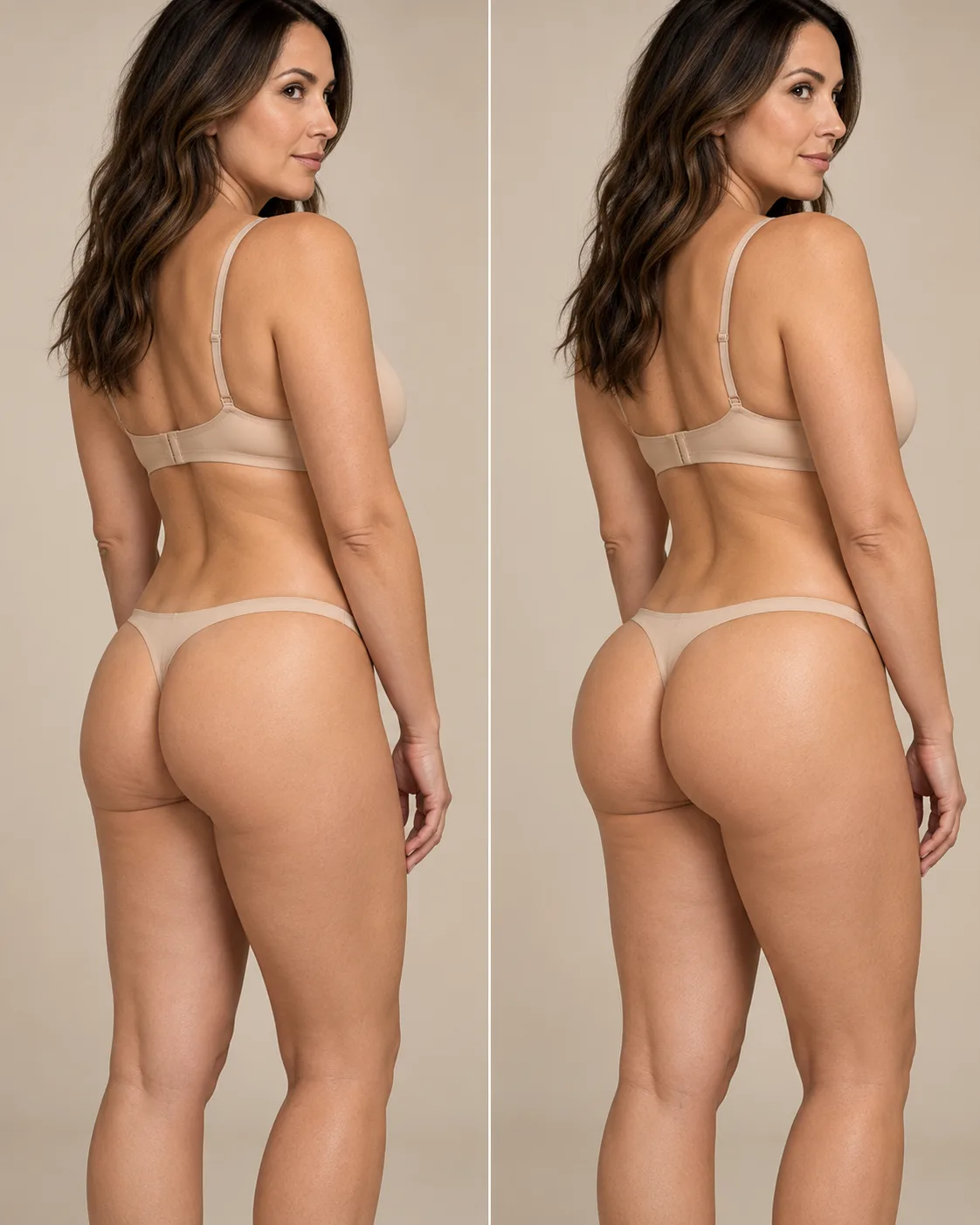
Butt implants and a Brazilian butt lift (BBL) create different shapes. Implants use a silicone device to add volume and projection. A BBL moves your own fat from other areas, which also contours the waist or hips. When comparing buttock augmentation before and after photos, check which method was used.
The table below summarises general differences. It is not advice about which suits you.
Feature | Butt implants | BBL (fat transfer) |
|---|---|---|
What adds volume | A silicone implant | Your own fat, after liposuction |
Typical shape | Rounder, with more projection, especially in the upper area | Softer, blended curves, often with a smaller waist |
Waist and hip contouring | Not a feature of the implant itself | Liposuction of donor areas changes the waist and hips |
Feel | Can feel firmer than natural tissue | Feels like natural fat when it survives |
Fat needed | Not required, so suits slim people with little fat | Needs enough donor fat |
Permanence | Implant remains unless removed or replaced | Some transferred fat is absorbed; the final volume is less predictable |
Main risks | Infection, wound problems, implant shifting, capsule changes | Fat absorption, uneven results and serious fat-related complications |
Why photos can look similar but differ
A gallery may place both types side by side. The final look can be close, but the route differs. A BBL often changes the whole silhouette because liposuction is part of it. Implants change the buttock only.
Safety considerations
Both carry real risks, and neither is risk-free. Modern guidance for BBL favours placing fat above the gluteal muscle. The American Society of Plastic Surgeons buttock augmentation page gives an overview of the options.
See both routes
If fat transfer interests you, look at our BBL before and after guide for how those results and healing look. Our main guide to BBL in Turkey explains the procedure in more detail. A surgeon can tell you whether one, the other, or neither suits your body.
How should you read butt augmentation before and after photos?
Butt augmentation before and after photos can teach you a lot. They can also mislead you. A good photo set is a record of one person's result, taken under fair conditions. A poor set is a marketing tool. Knowing the difference protects your expectations.
Treat every image as one piece of evidence, not a promise. Your own anatomy, skin and healing will decide your outcome.
A checklist for critical viewing
Use this list whenever you look at butt implants before and after pictures:
Lighting. Are the before and after shots lit the same way? Soft, angled light can smooth contours and hide dimpling.
Posture. Check stance, pelvic tilt and arching of the back. A small arch makes the buttock look more projected.
Camera angle and distance. A low angle or a wide lens can change how full a buttock looks.
Timing. When was the after photo taken? A photo at two weeks shows swelling. A photo at a year shows a settled result. Good sets state the time.
Editing. Look for smoothed skin, warped backgrounds or bent door frames and tiles. Filters can change shape.
Clothing and tanning. Underwear, fake tan, oil and tight fabric can all change how a result appears.
Relevant body type. Look for people with a similar height, frame and starting shape to yours.
Consent. Ethical providers show images only with written patient consent. Be wary of faceless, stolen or stock images.
Same source. Are the photos from the surgeon who would operate on you? Images borrowed from elsewhere tell you nothing about that team.
Full series. Ask for front, side, back and oblique views, not one flattering angle.
What photos still cannot tell you
A photo cannot show how an implant feels, how comfortable sitting is, or how the person felt during recovery. It cannot show complications that appeared later, or revision surgery.
If you are comparing fat transfer results too, our guide to BBL before and after applies the same critical approach.
Ask to speak with the surgeon about typical results and the range of outcomes, including less successful ones. A confident, honest team will welcome that question.
Which body types suit butt implants?
Butt implants tend to suit people who want more volume but do not have enough spare body fat to transfer. This often means slim or athletic frames. Suitability is always decided by a registered plastic surgeon after an examination, so the points below are general guidance only.
The American Society of Plastic Surgeons has an overview of buttock augmentation that explains the options, including implants and fat transfer, and what to discuss with a surgeon.
Features that may make implants a reasonable option
Little fat to harvest. If liposuction would not yield enough fat for the volume you want, an implant may be considered.
A wish for noticeable volume. Implants add a fixed amount of volume that does not depend on fat surviving.
Good general health. Your surgeon will review your medical history, medicines and any conditions that raise anaesthetic or healing risks.
A stable weight. Large weight changes after surgery can alter the look of the result.
Enough soft tissue. The skin and tissue need to cover and support the implant comfortably.
Realistic expectations. You understand that implants change shape and volume, but cannot copy another person's body.
Who may not be suitable
Some people should wait or choose another route. Your surgeon may advise against implants if you:
have an active infection or skin problem near the incision site
have a medical condition that makes surgery or anaesthesia unsafe
smoke or vape nicotine and are unwilling to stop, as this slows healing
are pregnant or planning a pregnancy soon
have unrealistic expectations or feel under pressure from others
have very thin or poorly healing tissue that may not cover an implant well
A good surgeon will also screen for body-image concerns that surgery may not solve, and may suggest talking to your GP or a counsellor first.
Why we avoid BMI figures here
A single number cannot judge suitability. Frame, muscle, skin and health all matter. Your surgeon will assess you as a whole person.
A fair consultation should leave you free to say no. If a clinic tells you every body is suitable, treat that as a warning sign.
How are implant size and shape chosen?
Choosing an implant is a shared decision between you and your surgeon. It is not a catalogue order. The aim is a result that suits your frame, your skin and your daily life, while staying within what your tissue can safely cover.
The consultation and measurements
A thorough consultation starts with your goals. You may be asked to bring buttock augmentation images that show the general look you like, such as a subtle lift or clearly more roundness. Pictures help communication, but they are a starting point rather than a target.
Your surgeon will then examine you standing and from several angles. They will usually assess the width of your pelvis, the height of your waist, the position of your hips, how much soft tissue you have, and how tight or loose your skin is.
Sizers and trying volumes
Some surgeons use external sizers. These are sample implants placed inside fitted underwear or shorts so you can see a rough idea of volume. They are not exact, because they sit outside the body, but they help you discuss preferences.
Volume is normally described in millilitres. Bigger is not better. An implant that is too large for your tissue can raise the chance of problems such as wound strain, visible edges or shifting.
Round versus oval shapes
Implants come in different shapes, and the choice affects the look:
Round implants tend to give fullness and projection across the buttock.
Oval implants can suit people who want a more elongated, athletic line.
Your surgeon will recommend a shape based on your anatomy and the effect you want.
Proportion and skin tension
Surgeons think about balance. Your buttocks sit in relation to your hips, waist, thighs and shoulders. A result that looks right on one person can look out of proportion on another.
Skin tension and soft-tissue coverage set practical limits. Tight skin can restrict how much volume fits comfortably. Thin coverage may let the implant edge show or be felt.
Ask your surgeon to explain why they recommend a particular size and shape, and what the alternatives would look like. You should leave understanding the reasoning, not just the number.
Where are butt implants placed?
Butt implants can be placed at different depths in relation to the gluteal muscle, the large muscle that forms much of the buttock. The three terms you will hear are subcutaneous, intramuscular and submuscular. Your surgeon chooses the plane based on your anatomy and goals. The descriptions here are general.
Subcutaneous placement
A subcutaneous implant sits just under the skin and fat, on top of the muscle. It can be technically simpler, but there is less tissue covering the implant. In slim people this may make the implant easier to see or feel, and a higher chance of visible edges or rippling. Many surgeons avoid this plane in people with little soft tissue.
Intramuscular placement
Here the implant is placed inside a pocket made within the gluteal muscle itself. This gives more coverage than subcutaneous placement, so the result can look and feel more natural. It is a technically demanding approach, and surgeons vary in how much they use it. Recovery can involve more soreness because the muscle is involved.
Submuscular placement
A submuscular implant lies beneath the muscle. This gives strong coverage, but it sits close to important structures such as nerves and blood vessels, which is why careful technique matters. It can also affect how the result moves and feels when the muscle contracts.
Comparing the trade-offs
Across the options, surgeons weigh the same factors:
Coverage: more tissue over the implant usually means a softer outline.
Feel: deeper placement can feel firmer when the muscle tenses.
Risk: each plane has its own risks, including infection, fluid collections, wound problems and implant movement.
Recovery: muscle involvement tends to mean more discomfort and a more careful return to activity.
No single plane is best for everyone. Ask your surgeon which one they recommend for you, how often they use it, and what they would expect your recovery to involve. Their experience with the chosen technique matters as much as the technique itself.
What do scars look like?
Scars are one of the details that butt implants before and after photos often hide. Most implant surgery leaves a scar, and understanding where it sits and how it changes helps you judge a result honestly.
Where the incision is usually made
The most common incision for butt implants is a short cut in the natal cleft, the vertical groove between the buttocks. The surgeon creates the pocket through this opening and places the implant. Some surgeons use other sites, but the cleft is widely used because the scar can be tucked out of sight.
Concealment and what to expect
Because the scar lies in a natural fold, it is usually hard to see from behind when standing. It may be more noticeable when you bend or when the buttocks are parted. Photos taken standing upright rarely show it, which is why a polished gallery can make surgery look scar-free. It is not.
How scars mature
Scars change over many months:
Early weeks: the line may look red, raised or firm, and can feel tight or itchy.
Several months: it often softens and flattens as healing continues.
Up to a year or more: the colour usually fades towards the surrounding skin, though some scars stay slightly different.
Colour changes are individual. Some people heal with pale scars, others with darker or raised ones. Skin tone, genetics, tension on the wound and aftercare all play a part. Some people are prone to thick scars called hypertrophic scars or keloids, so tell your surgeon if you have had these before.
Looking for scars in before and after butt implants photos
When you review before and after butt implants images, ask whether the series includes a close view of the cleft, and when it was taken. A scar shown at a year looks very different from one at three weeks.
Caring for the wound
Follow your surgeon's instructions on keeping the area clean and dry, avoiding strain, and returning for checks. Contact the team promptly if the wound opens, leaks, smells, or becomes red, hot or more painful. These can be signs of infection or wound breakdown and need prompt medical attention.
What risks do butt implant photos not show?
Photos show a shape. They cannot show what happens beneath the skin. When you study butt implants before and after images, remember that every operation carries risk, and gluteal implant surgery has a higher complication rate than many people expect. Your surgeon should explain this plainly and in detail.
The World Health Organization notes that harm in healthcare is a global concern and that patients benefit from open communication and well-run systems. Its patient safety fact sheet is a useful starting point for the questions you might ask any provider.
Risks your surgeon should discuss
Infection. Bacteria can reach the implant pocket. Mild cases may settle with antibiotics. Serious cases can mean removing the implant and waiting before trying again.
Wound opening. The incision between the buttocks is under tension and close to a moist area. It can open in part, which delays healing and may widen the scar.
Seroma. This is a collection of fluid around the implant. Small ones may be absorbed. Larger ones may need draining.
Implant shifting. An implant can move out of position, which may cause asymmetry or a visible lump.
Capsular contracture. The body forms a scar capsule around any implant. Sometimes it tightens, making the area firm, distorted or uncomfortable.
Nerve changes. Numbness, tingling or sensitivity can occur. It often improves, but may not fully resolve.
Asymmetry. Bodies are not perfectly symmetrical. Surgery cannot always correct this, and it can sometimes become more noticeable.
Implant exposure. If the wound breaks down, the implant can become visible through the skin. This usually needs further surgery.
Blood clots. Deep vein thrombosis (a clot in a leg vein) can occur after any operation. A clot that travels to the lungs is an emergency.
Anaesthetic risks. General anaesthesia can cause reactions, especially in people with heart, lung or other health conditions.
Why photos hide these problems
Most galleries show best outcomes. People who had complications may not share pictures. Even honest photos are a snapshot, and some problems appear months or years later.
Warning signs after surgery
Contact your surgical team urgently if you notice fever, spreading redness, heavy or foul-smelling discharge, a widening wound, calf pain or swelling, or breathlessness. Do not wait for a routine review. Seek emergency care for chest pain or sudden breathing difficulty.
No surgeon can promise a problem-free outcome. A good one will explain how risks apply to you and how they plan to manage them.
Do butt implants look natural?
Whether butt implants look natural is partly a matter of opinion. Some people want a subtle lift in shape. Others want a clearly fuller profile. Both are valid goals. What matters is that the result matches what you wanted and suits your body, not anyone else's idea of ideal.
Several factors shape how natural a result appears when you compare butt implants before and after pictures. Size is the first. Implants that are modest relative to your frame tend to blend with your existing outline. Very large implants on a slim frame can look more obviously augmented, because the skin and tissue have to stretch to cover them.
Coverage is the second factor. The amount of your own soft tissue over the implant affects how smooth the edges look and whether the outline of the implant can be seen or felt. People with little natural fat or thin skin may notice more of the implant's edge, especially when lying down or wearing close-fitting clothes.
Skin quality matters too. Good elasticity helps the skin settle smoothly. Looser skin, or skin with stretch marks, may not follow the new contour in the same way.
Movement and feel are often overlooked. A photo is still. In real life, the buttock moves as you walk, sit and climb stairs. Implants are firmer than fat, so some people notice that the area feels firmer to the touch than before. Over time this can soften slightly as swelling resolves, but implants will never feel identical to natural tissue.
Clothing fit changes as well. Jeans, trousers and swimwear may sit differently, and you may need different sizes. Many people find this a pleasant change. Some find it takes getting used to.
It helps to bring your own reference photos to your consultation, ideally images of bodies similar in height and frame to yours. Explain what you like about them. A surgeon can then tell you honestly what is achievable and what is not.
Try to avoid judging results against heavily edited social media images. Lighting, posing and filters can change how a buttock appears dramatically. Ask to see unedited, consistently lit photos taken at the same angles.
Can butt implants be combined with other procedures?
Yes, butt implants can sometimes be combined with other procedures in one operation. Whether that is wise depends on your health, your goals and your surgeon's judgement. Longer surgery means more time under anaesthetic and a harder recovery, so combining is a decision to make carefully rather than for convenience.
Common combinations
Liposuction for the waist. Removing fat from the waist or back can make the buttocks look relatively fuller by changing the proportions. It adds incisions and swelling elsewhere.
Fat transfer to refine shape. A small amount of your own fat can be placed to smooth edges or fill hollows. This is sometimes called a hybrid approach. It needs enough donor fat and careful technique, and not all of the fat will last.
Hip-dip correction. Hollows at the sides of the hips are caused by bone and soft tissue structure. Fat transfer is the usual way to soften them, and implants alone rarely do so.
Mommy makeover elements. After pregnancy, some people consider a tummy tuck or breast surgery as well. This is a major combined operation and is not suitable for everyone.
What combining adds
A longer operation and longer anaesthetic time.
More wounds to look after.
Greater swelling, bruising and discomfort.
A higher overall risk of complications, including clots.
Limits on how you can lie, sit and move during recovery.
Questions to ask
Is it safer to stage these procedures separately in my case?
How long will the whole operation take?
Which areas will I be unable to lie on, and for how long?
How many weeks of help will I need at home?
What happens if one area heals badly?
Some surgeons prefer to avoid doing too much at once. That is often a sign of caution, not unhelpfulness. If your plan includes fat transfer, our page on BBL before and after shows how that approach looks in photos.
A registered plastic surgeon should assess your general health, your skin and your goals before agreeing to any combination.
Do butt implants last, and can they be removed or replaced?
Butt implants are not guaranteed to last a lifetime. They are durable devices, but they are not designed to stay in place forever without any need for review. Many people keep their implants for a long time without problems. Others need further surgery for reasons that may or may not be related to the implant itself.
When you look at butt implants before and after photos, the "after" is usually only weeks or months old. Ask whether the clinic can show longer-term results and what follow-up they offer. Long-term outcomes are far more informative than early ones.
There are several reasons someone might need revision, removal or replacement. An implant may shift or become uncomfortable. A scar capsule can tighten. An infection may require removal. Wounds can open and expose the implant. Some people simply change their minds about size or shape as their life changes, and choose a smaller implant or removal.
Your body continues to change after surgery. Weight gain or loss alters the tissue around the implant, and so alters the shape. Pregnancy, hormonal changes and ageing affect skin and fat as well. An implant does not stop these changes, so the overall contour may look different years later even if the implant is perfectly intact.
Removal is possible but is also an operation. It carries the same general risks as other surgery. After removal, the skin may look looser or less smooth than before, because it has been stretched. Some people consider other procedures to address this. A surgeon can explain what to expect in your case.
Regular reviews are sensible. Ask when your surgeon would like to see you, and whom to contact if you have concerns after you return home. Keep your operation record, including the implant type, size and manufacturer details, in a safe place. Future surgeons will need it.
It is also worth asking what the provider's policy is on revision, and whether the cost of any corrective surgery would fall to you. Do not assume it is covered.
Be wary of anyone who promises permanent results. Honest surgeons talk about likelihoods, monitoring and the possibility of future surgery.
How should you prepare for surgery in Turkey?
Good preparation reduces avoidable problems. Travelling for surgery adds practical challenges, so plan carefully and take your time. The NHS explains the main issues in its guidance on cosmetic surgery abroad, including aftercare and what happens if something goes wrong once you are home.
A preparation checklist
Gather your medical history. List past operations, medicines, allergies, blood clot history, smoking or vaping, and any long-term conditions. Be completely honest with your surgeon.
Review photos critically. Look at butt implants before and after pictures that show your body type, and ask which are truly representative.
Complete an online assessment. A remote review lets a surgeon see your photos and history before you commit. It cannot replace an in-person examination.
Check surgeon registration. Ask for the surgeon's full name and registration details, and verify them with the relevant professional body. Confirm their training and experience with gluteal implants specifically.
Ask about the hospital. Find out whether it is accredited, whether it has intensive care and emergency facilities, and who looks after you overnight.
Time your flights. Ask how long you should stay in Turkey after surgery. Flying soon after an operation raises clot risk, so follow your surgeon's advice on timing.
Agree an aftercare plan. Know who will check your wounds, how you will contact the team, and how any complication would be handled once you are home in the UK or elsewhere.
Practical arrangements
Arrange someone to travel with you or meet you on return.
Plan comfortable seating, such as supportive cushions, for travel.
Prepare easy meals and loose clothing.
Check your travel insurance and read what it excludes.
Tell your GP about your plans so they can support you afterwards.
Finding out more
Our overview of BBL in Turkey explains safety standards and what to expect when having body-contouring surgery there. Read it alongside independent guidance.
If anything feels rushed or unclear, pause. A reputable team will welcome your questions and will not pressure you to book.
What questions should you ask your surgeon?
Photos are only one part of your research. A consultation is where you test whether a surgeon is right for you. Good surgeons welcome questions. Before you look at any more butt implants before and after galleries, write your own list and take it with you.
The questions below are a starting point. Ask them in writing if you can, so you have a record of the answers.
Questions about the surgeon and the facility
What is your training and registration? Ask which specialist body you are registered with, and whether you are a plastic surgeon. Ask how often you perform butt implant surgery, not just surgery in general.
Who will operate, and who will be in the room? Ask who gives the anaesthetic and who looks after you overnight.
Is the hospital accredited, and what happens in an emergency? Ask about intensive care access and transfer arrangements.
Questions about the implants
Which implant brand and model do you propose, and why? Ask for the implant documentation, including batch details, to be given to you in writing.
What are the alternatives for my body? A good surgeon explains why one size, shape or placement suits you better than another.
Where will the implants sit, and where will the scar be? Ask to see a diagram, not just a verbal description.
Questions about outcomes and problems
Can you show me photos of patients with a similar body shape to mine? Ask whether the photos are unedited and taken at similar angles and lighting.
What are the risks for me in particular? Ask about infection, wound problems, implant movement, asymmetry, capsular contracture (tight scar tissue around an implant) and clots.
What is your revision policy? Ask what is covered, for how long, and what you would pay if you need further surgery.
How do you handle complications after I fly home? Ask who answers messages, how fast, and who treats you in the UK if needed.
Questions about aftercare
What will recovery look like at home? Ask about garments, sitting, sleeping, drains, medicines and follow-up checks.
When can I fly, work and exercise? Ask for dates in writing.
The NHS guidance on cosmetic surgery abroad also lists questions worth asking and points to plan for before you travel.
If an answer is vague, or you feel hurried, pause. A clear, patient reply is a good sign. Pressure to book quickly is not.
How should you care for your results?
Aftercare shapes how your butt implants before and after photos will eventually look. Your surgeon's written instructions always come first. What follows is general information about what most programmes include, so you know what to ask about.
Day-to-day recovery habits
Compression garment: Most surgeons ask patients to wear a supportive garment for a set period. Wear it as directed, no more and no less.
Sitting: Many surgeons limit direct sitting for a time, or suggest sitting on a firm cushion or leaning to one side. Ask what your surgeon wants.
Sleeping: You may be asked to sleep on your front or side for a while. Avoid lying on your back unless told it is fine.
Movement: Short, gentle walks help circulation. Rest is still important.
Activity: Return to work, driving, lifting and exercise in stages. Squats and heavy leg work usually come much later and only with approval.
Follow-up and weight
Keep every follow-up appointment, including remote check-ins with photos.
Keep your weight stable. Large gains or losses change how the implants look and feel, because the tissue around them changes.
Protect your skin from strong sun while scars are young.
Scar care
Keep the wound clean and dry as instructed. Do not use creams, oils or massage on the scar until your surgeon says the wound has healed. Scars fade slowly over many months, and how they look varies between people.
Warning signs that need urgent help
Contact your surgical team straight away, or use emergency services, if you notice any of these:
Fever, or spreading redness, heat or swelling around a wound.
Wound edges opening, or fluid or pus leaking.
Severe or worsening pain that medicines do not ease.
One buttock suddenly much larger, tighter or more painful than the other.
Chest pain, breathlessness, a fast heartbeat or coughing blood. These can signal a blood clot in the lungs.
A painful, swollen or warm calf.
The NHS overview of cosmetic procedures is a useful reminder to know your aftercare plan before you travel. Save your surgeon's contact details, and your UK GP's, before you leave home.
How do you protect your wellbeing and expectations?
Looking at butt implants before and after pictures can be exciting. It can also be unsettling. Photos are chosen, lit and posed. They rarely show how a person felt, or how long they took to decide.
It helps to ask yourself why you want surgery. Wanting a change for yourself is a sound starting point. Feeling pushed by comments, trends or a partner is not. Your body is not a problem to fix, and no shape is the correct one. Surgery is a personal choice, and "no" or "not yet" are always valid answers.
Social media deserves extra care. Filters, angles, padding, clothing and editing can make results look more dramatic than they are. Posts from clinics and influencers are often marketing. Try to balance them with plain medical information and with accounts from people who had complications or regrets as well as happy outcomes.
A cooling-off period is one of the best protections you have. After your consultation, give yourself time. Many people find a few weeks is helpful. Read the consent form at home, not under time pressure. Talk to your GP if you have a history of low mood, anxiety or concerns about body image, because these deserve support before any surgery, not after it. Be wary of any team that offers deadlines or special deals to rush you.
Recovery can be emotionally bumpy. Swelling, bruising and limits on sitting and sleeping can make early photos look disappointing, and many people feel low in the first weeks. This is common, and it usually eases as swelling settles. Arrange support in advance: someone to help at home, someone to talk to, and a plan for contacting your surgeon if you are worried.
Satisfaction tends to be highest when expectations are realistic. A good result is usually a visible, natural-looking improvement that suits your frame, not an exact copy of someone else's photo. Aim for "better and comfortable" rather than "perfect". Ask yourself how you would feel if the result were good but modest, and whether that would still be worth the risks, the recovery and the cost.
Finally, be kind to yourself whatever you decide. The decision is yours alone.
How do you get a brazilian butt lift consultation and an honest assessment?
If you are comparing implants with fat transfer, the first practical step is a free online assessment with a Turkish plastic surgeon. You can request a brazilian butt lift consultation even if you are leaning towards implants, because the surgeon can explain which route may suit your body. It is a conversation, not a commitment.
The assessment usually starts with a short form. You describe your goals, your height and weight, your medical history, any medicines you take, and any previous surgery. Be completely honest here. Details such as smoking, clotting problems, diabetes or past complications change what is advisable.
You will normally be asked for photos. Clear, well-lit pictures from the front, back and both sides, taken in underwear against a plain background, help the surgeon see your shape, skin and proportions. Photos you like from other people can be useful for discussing your taste. A good surgeon will treat them as a talking point, not a promise.
A remote review can tell you a fair amount. A surgeon can judge your general proportions, how much soft tissue you have, whether fat transfer or implants look more suitable, and what questions need answering. They can also explain the risks, the recovery plan and the travel arrangements.
There are limits. Photos cannot show skin elasticity as well as touch can. They cannot replace a physical examination, blood tests or a proper check of your general health. A surgeon cannot guarantee a result from a screen. If anyone does, treat that as a warning sign.
That is why an in-person review before surgery matters. The surgeon should examine you, confirm the plan, mark your body, go through the consent form and answer questions again. You should be free to change your mind at that point without pressure.
When you speak to the team, bring your list of questions and any butt implants before & after photos you have saved. Ask what each image shows and whether it matches your body type.
Ready to take a calm first step? Use our free online assessment to share your goals and receive honest, individual feedback. For more on how fat transfer results look over time, see our guide to BBL before and after results. You can also read BAAPS for UK-focused patient information while you decide.
Photos are a helpful starting point, but your own anatomy, health and goals decide what is possible. Take your time, ask detailed questions and be wary of anyone who rushes you or promises a particular result.
When you are ready, you can request a free online assessment. A surgeon will review your photos and goals and explain, honestly, whether implants, fat transfer or no surgery at all may suit you best.
Frequently asked questions
How long until butt implant results look final?
Most swelling eases over the first few weeks, but the shape keeps changing for months. Implants soften and settle into position, and scars fade last. Many people see a result close to final at around six months to a year. Your surgeon will tell you when to judge the outcome for your own body.
Do butt implants look natural in photos?
It depends on implant size, placement, skin thickness and your starting shape. A moderate, well-chosen implant usually blends with your own tissue, while a very large one on a small frame can look out of proportion. Natural is also a matter of taste, so discuss your preferences with your surgeon.
Are butt implant before and after photos reliable?
Only if they are taken fairly. Look for the same angle, lighting, distance and pose in both photos, no filters, and a stated time since surgery. Photos taken a few days after an operation show swelling, not the settled result. Also remember that each photo shows one person, not a promise for you.
What is the difference between butt implants and a BBL?
Butt implants add volume with a solid silicone device placed through a small incision. A Brazilian butt lift moves your own fat from other areas after liposuction. Implants suit people with little spare fat, while a BBL also reshapes the donor area. Each has different risks, so a surgeon should advise you.
Do butt implants leave visible scars?
Butt implants need an incision, so there is a scar. It is usually placed where clothing and the natural fold of the buttocks can hide it. Scars start red or raised and fade over many months. How visible they end up varies from person to person, so ask your surgeon where yours would sit.
Can I see butt implants images from patients like me?
Ask your surgeon for photos of patients with a similar height, frame and starting shape to yours. These are more useful than a general gallery. Ask also how long after surgery each photo was taken. A responsible surgeon will be open about limits and will not promise you a particular result.
Do butt implants last forever?
Implants are not considered lifetime devices, and some people need a revision, replacement or removal at some point. Reasons include capsule tightening, movement, infection, or a change in preference. Regular follow-up helps. Ask your surgeon what long-term care and revision options would involve for you before you decide.
Sources
References used for this article. Figures are only quoted when a source is listed.
- Cosmetic procedures — NHS
- Buttock augmentation — American Society of Plastic Surgeons
- Patient safety fact sheet — World Health Organization
About the author
BBL Turkey Editorial Team
Our editorial team writes patient guides together with our plastic surgeons. Medical content is reviewed for accuracy before publication and updated as guidance changes.

Medically reviewed by
Op. Dr. Caner Gelbal
Plastic, Reconstructive & Aesthetic Surgeon
- Specialist in Plastic, Reconstructive and Aesthetic Surgery (Türkiye)
Op. Dr. Caner Gelbal is a plastic, reconstructive and aesthetic surgeon at Medipol Bahçelievler University Hospital, Istanbul. He graduated from Istanbul Faculty of Medicine in 2017.
View full profileReady to talk to a surgeon?
Send your photos for a free, no-obligation assessment. A coordinator replies within 24 hours — no pressure, no time-limited offers.


